A steering problem can turn an ordinary drive across Las Vegas into a stressful one, especially in heavy traffic on I-15, US-95, or busy surface streets. Heat, road wear, dust, and daily stop-and-go driving can all add strain to steering and suspension components over time.
Quick answer: Basic steering checks such as monitoring power steering fluid, checking tire pressure, and noticing changes in steering feel are reasonable DIY tasks. Actual steering repairs are usually better left to a professional because the system directly affects vehicle control and safety. If the wheel feels loose, becomes difficult to turn, pulls unexpectedly, makes grinding or clunking noises, or steering fluid is leaking, a professional inspection is the safer next step.
What local drivers should know
A sudden change in steering effort, response, or stability should be investigated rather than ignored.
Extreme Southern Nevada heat can accelerate deterioration of rubber components, seals, hoses, and fluids.
Rough pavement, potholes, curbs, and road debris around Clark County can contribute to steering or suspension wear.
Checking tire pressure and looking for visible leaks can help identify a problem, but those checks do not replace diagnosis.
Steering components are safety-critical, so repairs that involve disassembly, hydraulic systems, electronic steering, or alignment should generally be handled professionally.
Why Do Steering Problems Matter for Las Vegas Drivers?
Steering problems matter for Las Vegas drivers because reliable vehicle control is essential in high-speed freeway traffic, congested intersections, and extreme summer conditions. A small amount of looseness or delayed steering response can become much more noticeable when changing lanes, avoiding road debris, or maneuvering through dense traffic.
Southern Nevada driving also puts vehicles through demanding conditions. Summer pavement temperatures can be severe, while dust and dry conditions are common throughout the valley. Drivers traveling between Summerlin, Paradise, Spring Valley, North Las Vegas, and Henderson may encounter a combination of freeway miles, stop-and-go traffic, construction zones, and uneven pavement.
Mobile Mechanics Las Vegas helps local drivers address vehicle problems where mobile service is appropriate. After this first mention, we focus on helping customers understand what may be happening, which checks are reasonable, and when a steering concern needs professional attention.
What Local Conditions Can Contribute to Steering Wear?
Local steering wear can be influenced by extreme heat, rough roads, frequent driving, dust exposure, and impacts from potholes or curbs. These conditions do not automatically cause steering failure, but they can increase stress on components that are already aging or worn.
In Southern Nevada, prolonged heat can be hard on rubber boots, seals, hoses, and certain fluids. Dry conditions and road dust can also collect around exposed suspension and steering areas.
Road conditions matter as well. Hitting a pothole, curb, or broken pavement can affect tie rods, steering linkage, wheels, tires, or alignment. Drivers who regularly travel construction-heavy routes around Clark County may notice pulling, uneven tire wear, or changes in steering feel after a significant impact.
These are general mechanical observations rather than claims that every local vehicle will experience the same problems.
How Can a Steering Problem Affect Your Vehicle?
A steering problem can affect control, tire wear, handling, driver confidence, and the ability to respond quickly to changing road conditions. Depending on the cause, a vehicle may become harder to turn, wander in its lane, pull to one side, or respond inconsistently to steering input.
Some steering concerns are connected to other systems. A damaged tie rod can affect alignment. Incorrect tire pressure can make steering feel unusual. Worn suspension components may create symptoms that feel like a steering problem.
Because several issues can produce similar symptoms, replacing a part based only on a noise or steering sensation can lead to unnecessary expense without solving the original problem.
What Are the Warning Signs of Steering Trouble?
Common steering warning signs include unusual resistance, looseness, pulling, fluid leaks, noises, vibration, and delayed response from the steering wheel. Drivers should pay particular attention when a symptom appears suddenly or becomes noticeably worse.
Watch for:
The steering wheel becoming unusually hard to turn.
Excessive free play or looseness in the steering wheel.
The vehicle wandering or pulling while driving on a reasonably level road.
Clunking, popping, whining, squealing, or grinding during turns.
Visible fluid underneath the front portion of the vehicle.
Steering-wheel vibration that was not present before.
Uneven or unusually rapid tire wear.
A steering or power steering warning light appearing on the dashboard.
A warning sign does not identify the failed component by itself. Diagnosis is what separates a tire, alignment, suspension, hydraulic, or steering-system issue.
When Should You Call a Professional for Steering Repairs?
You should call a professional when steering performance changes noticeably, a leak is present, parts appear loose or damaged, warning lights appear, or the vehicle no longer feels predictable to control. Basic observation is useful, but steering-system disassembly and repair are generally not good trial-and-error DIY projects.
A driver can safely check tire pressure according to the vehicle’s recommended specifications, inspect the ground for obvious leaks, and note exactly when noises or handling changes occur.
Professional help becomes more appropriate when the repair could involve tie rods, a steering rack, power steering hoses, a pump, electronic power steering components, steering linkage, or related suspension parts. If the vehicle feels unsafe to control, avoid treating the trip to a repair facility as a test drive.
What Are Common Causes of Steering Problems in Southern Nevada?
Common causes of steering problems include tire issues, alignment changes, worn linkage, leaking hydraulic components, aging steering parts, and related suspension wear. Local heat and road conditions can contribute to how quickly existing wear becomes noticeable.
1. Tire pressure or tire damage: Low pressure, uneven wear, or a damaged tire can cause pulling and heavier steering.
2. Alignment changes: A pothole or curb impact can alter alignment and make a vehicle pull or feel unstable.
3. Worn tie rods or linkage: Wear in components connecting steering input to the wheels can create looseness, clunking, or inaccurate response.
4. Power steering fluid leaks: Vehicles with hydraulic power steering may become difficult or noisy to steer when fluid is lost.
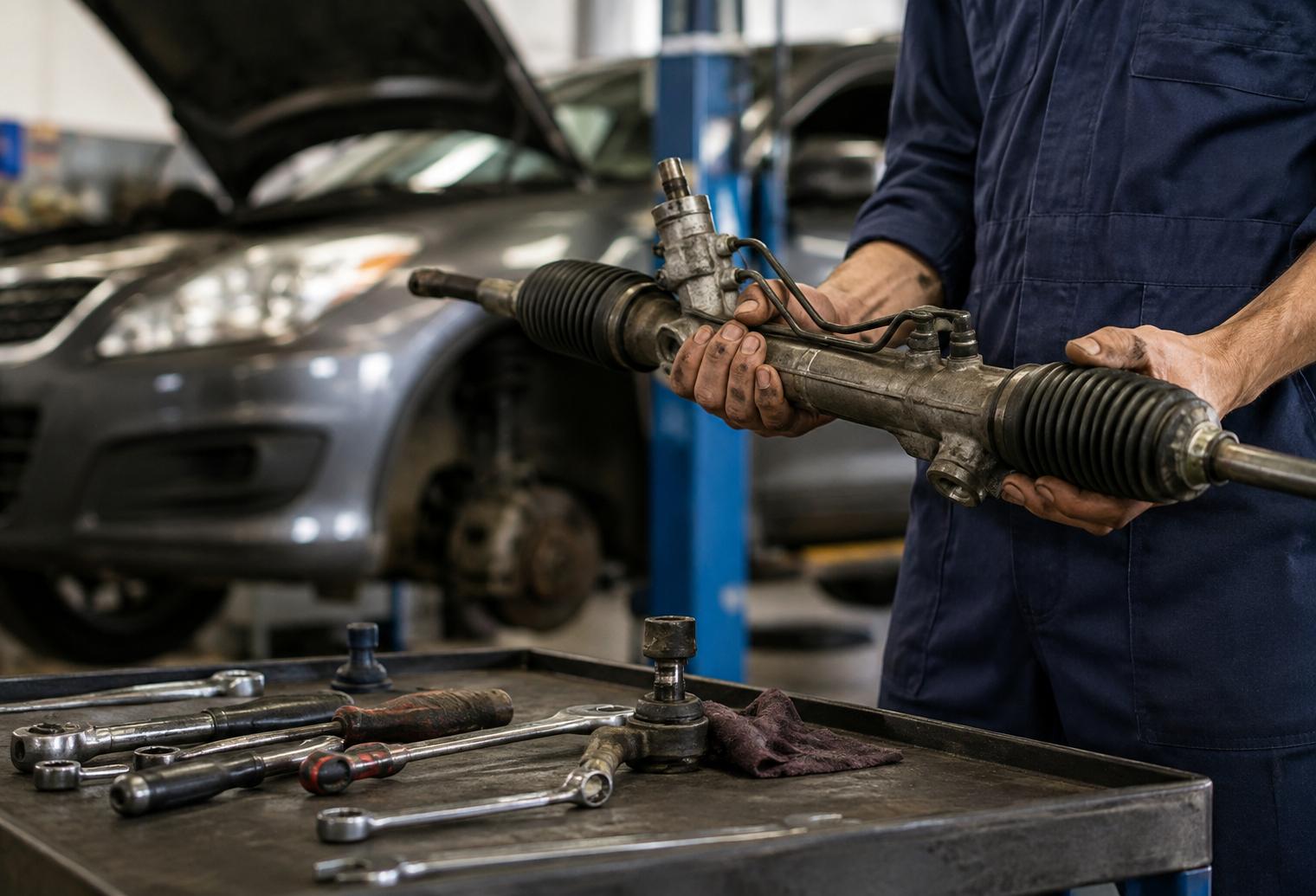
5. Steering rack or pump problems: Internal steering-system problems can produce leaks, inconsistent assistance, noise, or increased effort.
6. Suspension wear: Ball joints, control-arm components, bushings, and other suspension parts can create handling symptoms that resemble steering trouble.
What Steering Maintenance Can You Do Yourself?
DIY steering maintenance should focus on observation, tire care, fluid checks when applicable, and catching changes before they become larger problems. These simple checks are especially useful before long drives across the valley or during periods of intense summer heat.
Check tire pressure regularly and inspect tires for unusual wear. If your vehicle uses serviceable power steering fluid, check the level according to the owner’s manual and use only the specified fluid type.
Look underneath the vehicle for new leaks and pay attention to changes in steering feel. If you hit a significant pothole or curb, monitor the vehicle for pulling, vibration, an off-center steering wheel, or new noises.
DIY work should stop when diagnosis requires lifting the vehicle, separating steering components, disturbing safety-critical fasteners, working with electronic steering systems, or performing an alignment.
What Results Should You Expect From Professional Steering Repair?
Professional steering repair should aim to identify the actual source of the symptom and restore predictable steering operation based on the condition of the vehicle. The exact repair depends on whether the problem comes from tires, alignment, steering components, suspension parts, hydraulic assistance, or an electronic system.
A proper diagnosis can also uncover related concerns. For example, replacing a worn steering component may be only part of the solution if alignment or tire wear has also been affected.
No legitimate repair should be expected to correct unrelated mechanical problems, which is why diagnosis before parts replacement is valuable.
What DIY Steering Repair Mistakes Should Drivers Avoid?
The biggest DIY steering mistakes are guessing at the failed part, ignoring related components, using incorrect fluids, and continuing to drive despite worsening symptoms. These mistakes can increase repair costs or leave the original safety concern unresolved.
Mistake: Replacing a component because an online video showed similar symptoms. Consequence: Several steering and suspension faults can feel alike. Better approach: Diagnose the source before buying parts.
Mistake: Adding whatever power steering fluid is available. Consequence: Fluid requirements vary by vehicle. Better approach: Verify the manufacturer’s specification first.
Mistake: Assuming pulling always means the steering rack is failing. Consequence: Tire pressure, alignment, tire damage, and suspension wear can also cause pulling. Better approach: Check the complete steering, tire, and suspension picture.
Mistake: Continuing to drive as looseness or steering effort increases. Consequence: A controllability problem can become more serious. Better approach: Arrange an inspection when the vehicle’s handling changes significantly.
What Is a Common Local Steering-Repair Scenario?
A common local scenario is a driver noticing new pulling, vibration, or an off-center steering wheel after striking rough pavement or a pothole. This does not automatically mean a major steering component has failed, but an impact can affect tires, wheels, alignment, steering linkage, or suspension components.
For example, a driver commuting between Henderson and central Las Vegas might notice the vehicle no longer tracks straight after a hard road impact. Checking tire pressure is a sensible first step. If the symptom remains, a professional inspection can identify whether alignment or damaged components are involved.
This is an illustrative local scenario, not a customer case study.
Which Services Can Help Resolve Steering Problems?
Steering problems may require diagnostic service, steering-component repair, suspension inspection, fluid-leak diagnosis, or related mechanical repairs depending on the cause. The right service should follow the symptom rather than assuming a specific part needs replacement.
We can help evaluate vehicle concerns and determine which repairs are appropriate for mobile service. Some situations may require equipment or procedures better suited to a repair facility, particularly when specialized alignment or other shop-based equipment is necessary.
Is DIY Steering Repair Better Than Calling a Professional?
DIY checks are useful for simple observations, but professional diagnosis is the better choice when steering components, vehicle control, or safety are involved. The dividing line is whether the task involves basic monitoring or an actual repair to a system that determines where the vehicle goes.
DIY makes sense for checking tire pressure, observing fluid levels, inspecting for obvious leaks, and documenting symptoms.
Calling a professional makes more sense for persistent pulling, loose steering, leaks, steering noises, damaged linkage, electronic power steering warnings, or any situation where parts must be removed or adjusted.
For most Las Vegas drivers, the potential savings of guessing at a steering repair are difficult to justify if an incorrect repair leaves the original problem unresolved.
What Areas Can Receive Local Steering-Repair Help?
Local steering-repair assistance may be available throughout the Las Vegas area depending on the vehicle, location, and type of service required. Our service area can include communities across the valley, with drivers in areas such as Summerlin, Spring Valley, Paradise, and surrounding Clark County communities seeking help for vehicle concerns.
Drivers in nearby Henderson or North Las Vegas should confirm service availability for their specific location and repair need.
What Can Happen If You Ignore a Steering Problem?
Ignoring a steering problem can lead to worsening handling, uneven tire wear, additional component stress, or a more serious loss of predictable vehicle control. The risk depends on the failed component, but waiting is rarely useful when the symptom is becoming more noticeable.
A minor alignment issue may accelerate tire wear. A leaking hydraulic system can lose additional fluid. Worn linkage may develop more movement. In busy Southern Nevada traffic, predictable steering response matters every time a driver merges, turns, brakes, or avoids an obstacle.
These common steering-repair questions can help Las Vegas drivers decide what they can check themselves and when professional diagnosis is appropriate.
Can I drive with a steering problem in Las Vegas?
You should avoid driving if the vehicle is difficult to steer, unusually loose, unpredictable, or clearly unsafe to control. Minor symptoms still deserve attention because steering problems can worsen. If you are unsure whether the vehicle is safe to move through local traffic, professional guidance is preferable to using a drive as a diagnostic test.
Does Las Vegas heat damage power steering systems?
Extreme heat can contribute to deterioration of fluids, hoses, seals, rubber components, and other aging vehicle parts. Heat alone does not prove why a steering system is malfunctioning, but Southern Nevada conditions can add stress to components. Visible leaks, noise, or increased steering effort should be diagnosed rather than attributed to temperature alone.
Why is my steering wheel suddenly hard to turn?
A steering wheel can become hard to turn because of low tire pressure, a hydraulic power steering problem, a fluid leak, a failed pump, an electronic steering fault, or another mechanical issue. Because some causes can affect vehicle control, a sudden or severe increase in steering effort should be inspected promptly.
Can a Las Vegas pothole cause steering problems?
Yes, a strong pothole or curb impact can affect tires, wheels, alignment, steering linkage, or suspension components. After a hard impact, watch for pulling, vibration, an off-center steering wheel, unusual noises, or changes in handling. Persistent symptoms should be professionally inspected so damaged parts are not mistaken for a simple alignment issue.
Is a power steering fluid leak a DIY repair?
Finding the source of a power steering fluid leak is usually more important than simply adding fluid. A leak may come from a hose, fitting, pump, rack, or another component. Drivers can monitor the fluid level where appropriate, but repairing the leak typically requires proper diagnosis, parts, tools, and safe working procedures.
Why does my vehicle pull on roads around Clark County?
Pulling can result from tire pressure differences, tire wear, alignment problems, steering wear, suspension issues, or road surface conditions. If your vehicle repeatedly pulls on different roads rather than only on a noticeably crowned roadway, check the tires first and consider a professional steering, suspension, and alignment evaluation.
Should I repair steering components myself to save money?
DIY steering repairs can create false savings if the wrong component is replaced or the vehicle requires alignment afterward. Basic checks are worthwhile, but safety-critical components should be diagnosed correctly. For local drivers who depend on their vehicles for commuting across the valley, reliable steering is more important than experimenting with parts.
Do steering repairs always require a repair shop?
Not every steering-related concern necessarily requires traditional shop service. Some inspection and repair work may be suitable for mobile service, while alignment procedures or certain specialized repairs can require shop equipment. We can help determine what type of service makes sense based on the symptoms, vehicle, and suspected problem.
Make Your Next Drive Feel Predictable Again
Addressing steering concerns early can help protect predictable handling on Las Vegas streets and freeways. We focus on identifying the problem, explaining the available repair path, and helping local drivers determine whether mobile service fits the job.
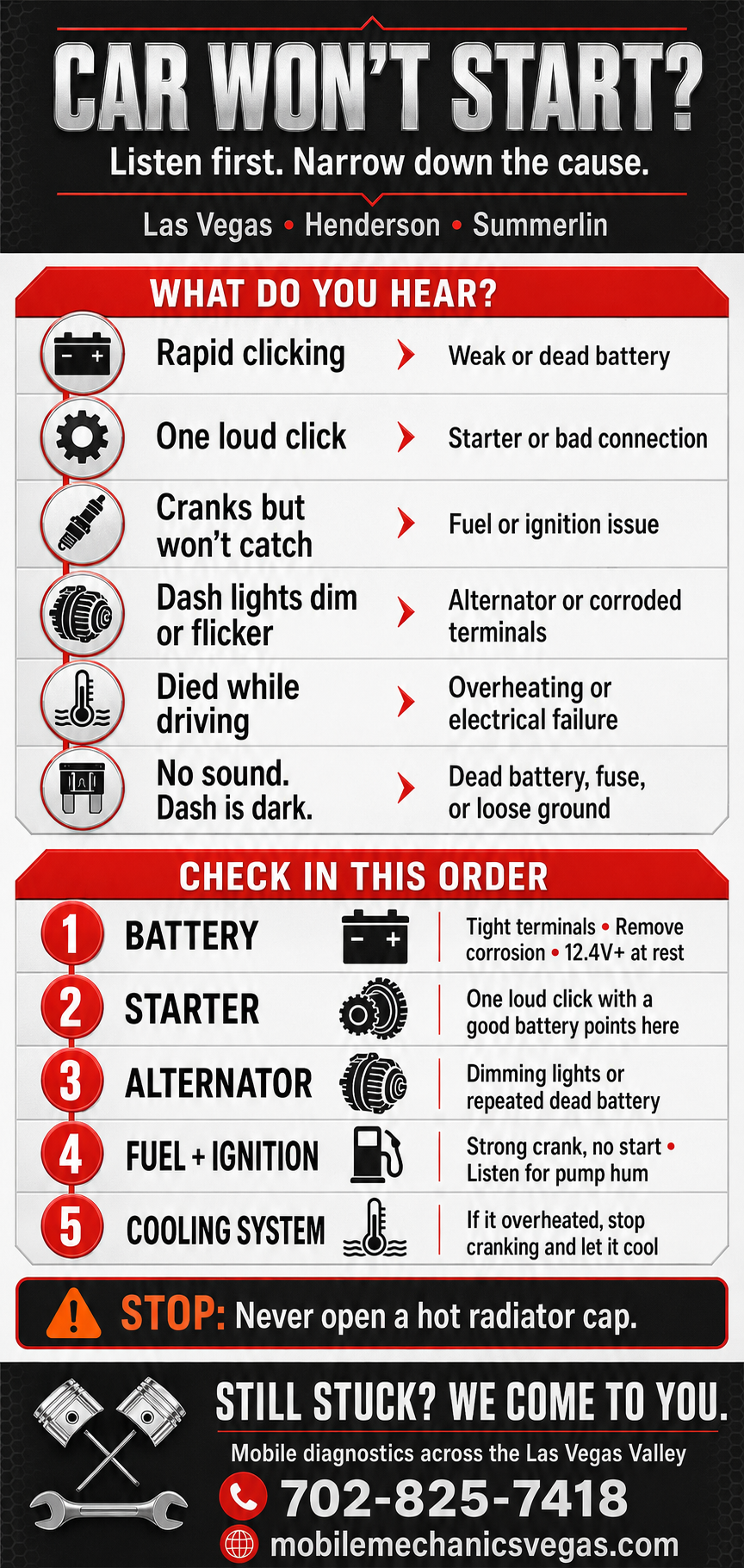
Turning the key and hearing nothing (or hearing a click, a whine, or a sluggish crank) is one of the most common calls we get across Las Vegas, Henderson, and Summerlin. The good news: most no-start problems trace back to just a handful of causes, and you can narrow it down in a few minutes before ever popping the hood. Here’s how to work through it in order, starting with the most likely culprit in our desert heat.
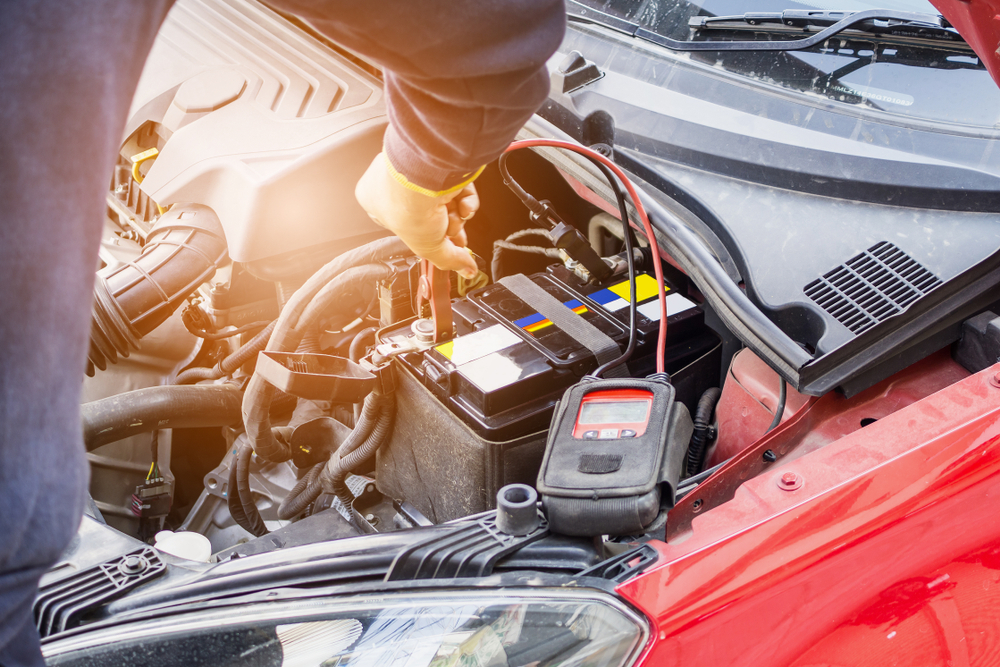
Las Vegas heat is brutal on batteries. Constant triple-digit temperatures break down internal components faster than cold climates ever would, so most batteries here only last two to three years instead of the five you might get elsewhere. Check for corrosion on the terminals (a white or greenish crust), make sure the cable clamps are tight, and if you have a multimeter, look for at least 12.4 volts at rest. Anything under 12 volts usually means the battery is on its way out or already dead.
Listen for the Starter
If the battery tests fine but you get a single loud click and nothing else, the starter motor or solenoid is the next suspect. A worn starter often struggles more after the car has been sitting in a hot garage or parking lot all day, since heat expands metal components and can cause intermittent contact issues. This isn’t something to diagnose by guesswork for long. If tapping the starter housing gets it to turn over once, that’s a strong sign it needs replacing soon.
Check the Alternator
The alternator keeps your battery charged while you drive. If it’s failing, the car might start fine in the morning but die later, or your battery might test fine while the alternator quietly isn’t recharging it. Dimming headlights at idle, a battery warning light, or a battery that keeps dying even after a jump are all signs the alternator, not the battery, is the real problem.
Fuel and Ignition Problems
If the engine cranks strong but won’t fire up, fuel or spark is missing from the equation. A clogged fuel filter, failing fuel pump, or worn spark plugs are common causes, especially in older vehicles that haven’t had routine maintenance. You can sometimes hear the fuel pump prime (a brief hum) when you turn the key to the on position. No hum at all can point to a dead fuel pump or a blown fuse.
Overheating Shutdowns
Summer driving around the valley puts real strain on cooling systems, especially in stop-and-go traffic on the Strip or idling in a hot parking lot. If your car stalled from overheating and now won’t restart, don’t keep cranking it. Let it cool fully, check the coolant level once it’s safe to touch the radiator cap, and have the cooling system inspected before driving further. Restarting an overheated engine repeatedly can cause serious damage.
System
Quick Check You Can Do
When to Call a Mechanic
Battery
Check terminals, test voltage
Voltage low, over 3 years old
Starter
Listen for clicks vs. silence
Single click, no crank
Alternator
Watch for dimming lights
Battery keeps dying after charging
Fuel System
Listen for fuel pump hum
Cranks but never starts
Cooling System
Check temp gauge, coolant level
Stalled from overheating
Not every no-start is a DIY fix, and in the Las Vegas heat, guessing wrong can turn a small issue into a stranded afternoon. If you’ve gone through these checks and your car still won’t start, our mobile mechanics can come to you, diagnose the exact cause, and get you back on the road without a tow.
Sometimes the issue isn’t any single part but a loose ground wire, a blown fuse, or corroded wiring from years of desert dust and heat cycling. Car electrical problems can be maddening because they’re intermittent. If your car starts sometimes and not others with no clear pattern, an electrical short or bad connection is often to blame, and it usually takes a trained eye with the right tools to track down.
When to Stop Troubleshooting and Call for Help
If you’ve checked the battery, listened for the starter, and still have no answers, it’s time to bring in a professional rather than keep draining a weak battery with repeated attempts. At Mobile Mechanics Las Vegas, we come straight to your driveway, workplace, or wherever you’re stuck anywhere in the Las Vegas valley, run a full diagnostic on site, and handle the repair without the hassle of a tow truck.
We have all been there. You notice something slightly off about your car, tell yourself it is probably nothing, and keep driving. Maybe the check engine light has been on for a few weeks, or you hear a faint squeak every time you hit the brakes. Life gets busy, and small car repair needs have a way of sliding to the bottom of the priority list. But here is the truth: ignored car repairs rarely stay minor for long. What starts as a $50 fix can quietly snowball into a $1,500 headache if you look the other way long enough.
Whether you are driving through the scorching streets of Las Vegas, Nevada, or commuting across any sun-baked stretch of the American Southwest, your vehicle takes on a lot of daily stress. Heat, dust, stop-and-go traffic, and long highway stretches all accelerate wear on components that might otherwise last longer in milder climates. That is why urgent car maintenance is not just good advice; it is a financial survival strategy for any driver who wants to avoid being stranded on the side of the road.
Let us walk through the top five minor car repairs that drivers most commonly put off, and why each one deserves your attention sooner rather than later.
1. Worn Brake Pads
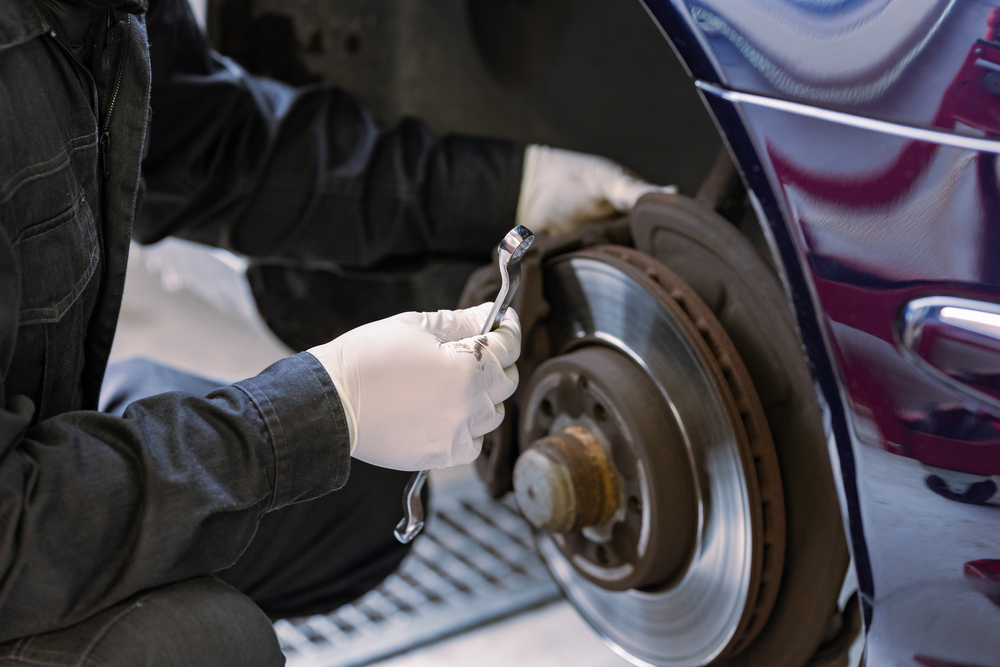
If your car is producing a high-pitched squealing noise when you press the brake pedal, that sound is not a fluke. Brake pads are equipped with small metal wear indicators designed to make exactly that noise when the pad material has worn too thin. It is the system working as intended, alerting you that action is needed.
Many drivers hear this sound and delay the repair for weeks or even months. This is one of the most costly examples of ignored car repairs in the automotive world. Once the brake pad wears completely through, the metal caliper begins grinding directly against the brake rotor. Rotors are significantly more expensive to replace than pads. A standard brake pad replacement might cost between $100 and $200 per axle, but rotor replacement can push that figure to $400 or more per axle, sometimes higher depending on the vehicle.
Beyond the financial damage, worn brakes are a safety issue. Stopping distances increase, and in emergency situations, every foot of extra stopping distance matters. This is not a small car repair you want to gamble with, especially in high-traffic areas where quick stops are part of daily driving.
2. Low or Leaking Coolant
Coolant, sometimes called antifreeze, is what keeps your engine from overheating. In hot climates, particularly in desert cities like Las Vegas, Nevada, the cooling system works overtime. Temperatures regularly climb above 100 degrees Fahrenheit during summer months, and an engine that is already operating at high temperatures simply cannot afford a compromised cooling system.
A slow coolant leak might not seem alarming at first. You top off the reservoir, and the car seems fine. But a leak is a symptom of a larger problem, whether it is a cracked hose, a failing water pump, or a deteriorating radiator. Each of those components costs far more to replace if they are pushed past the point of minor repair.
More importantly, an overheating engine can cause catastrophic internal damage in a matter of minutes. Head gasket failure, a warped cylinder head, or even a seized engine are all possible outcomes when a cooling system is ignored. These repairs can cost several thousand dollars and sometimes exceed the value of the vehicle itself. Addressing a coolant issue early is one of the clearest examples of why urgent car maintenance pays for itself many times over.
3. Cracked or Chipped Windshield
A small chip in your windshield might look like a cosmetic problem, but it is actually a structural one. The windshield contributes to the overall rigidity of your vehicle’s cabin. In the event of a rollover, a compromised windshield is far less capable of supporting the roof and protecting occupants.
A chip the size of a quarter can typically be repaired for $50 to $100. Left alone, that same chip spreads across the glass as temperatures fluctuate, vibrations travel through the vehicle, and UV exposure weakens the surrounding material. Once a crack extends more than a few inches, most repair technicians cannot fix it; a full windshield replacement becomes necessary, costing anywhere from $200 to $500 or more depending on the make and model.
For drivers in Las Vegas and surrounding Nevada communities, the combination of intense heat, cold nights, and rough highway conditions creates ideal circumstances for chips to spread rapidly. This is one small car repair that can be handled quickly and inexpensively at dozens of local auto glass shops, and there is very little reason to delay it.
4. Faulty Oxygen Sensor
The check engine light strikes fear into some drivers and is completely ignored by others. While not every check engine code signals immediate danger, a faulty oxygen sensor is one of the most common causes of that warning light, and it is also one of the most underestimated ignored car repairs on the road today.
The oxygen sensor monitors the ratio of oxygen in your exhaust gases and sends that data to the engine control unit. When it fails, your engine cannot properly adjust the fuel mixture. The result is a car that burns more fuel than necessary, sometimes decreasing fuel efficiency by as much as 40 percent according to some industry estimates. For a driver who fills up twice a week, that adds up to a noticeable monthly expense on top of the cost of the repair itself.
A faulty oxygen sensor can also cause the catalytic converter to fail prematurely. The catalytic converter is one of the more expensive components in your vehicle’s emissions system, with replacement costs often ranging from $800 to $1,200 or higher. Replacing an oxygen sensor, on the other hand, typically costs between $150 and $300. The math makes a compelling case for urgent car maintenance when that check engine light comes on.
5. Tire Wear and Pressure Issues
Tires are your vehicle’s only contact with the road, which makes their condition directly linked to your safety and your wallet. Uneven tire wear is often a sign of misaligned wheels or a suspension issue. Consistently low tire pressure accelerates wear, reduces fuel efficiency, and increases the risk of a blowout.
A basic tire rotation and wheel alignment are among the most affordable services you can have performed, usually totaling under $100 combined. Yet drivers routinely skip these services until uneven wear forces an early tire replacement. A quality set of tires can cost anywhere from $400 to $800 or more, and having to replace them ahead of schedule because of neglected maintenance stings both financially and practically.
In a city like Las Vegas, where summer road surfaces regularly reach extreme temperatures, tires that are already compromised by uneven wear or low pressure face accelerated degradation. A blowout at highway speed is not just expensive; it is genuinely dangerous. Checking your tire pressure monthly and scheduling rotations every 5,000 to 7,500 miles is simple, low-cost preventative care that extends the life of your tires considerably.
Conclusion
None of the repairs covered here require advanced mechanical knowledge or a large time commitment. They are all manageable, affordable when caught early, and significantly more expensive when ignored. Ignored car repairs have a compounding effect; a small problem today becomes a large one tomorrow. Whether you are managing a tight budget or simply trying to keep your vehicle on the road for as long as possible, staying current with urgent car maintenance is one of the smartest financial decisions a driver can make. Do not wait for a warning sign to become a breakdown. Schedule that small car repair today and give yourself the peace of mind that comes with knowing your vehicle is ready for whatever the road brings.
Need Mobile Mechanics Near You?
At Mobile Mechanics Las Vegas, we’re here to make auto repair simple, convenient, and stress-free by bringing the shop directly to you anywhere in Las Vegas, North Las Vegas, or Henderson. Whether it’s diagnostics, major repairs, brake or electrical issues, or even fleet, RV, or hydraulic service, our skilled team is ready to get you safely back on the road without the hassle of a shop visit. Don’t wait around; reach out to ustoday and experience the quality, reliability, and convenience that sets us apart!
Las Vegas is a city that never really slows down. Between busy work schedules, long commutes across the valley, and a lifestyle that often runs late into the evening, many residents simply do not have time to sit in a repair shop waiting room for hours. For drivers throughout the city, the traditional approach to vehicle maintenance is starting to feel outdated. That is why more people are turning to mobile auto technicians who bring professional service directly to their homes, workplaces, or even roadside locations.
Mobile repair services are changing the way people handle Las Vegas car repairs. Instead of scheduling an appointment weeks in advance and rearranging your day around a trip to the shop, vehicle owners can now receive convenient automotive services wherever their car happens to be parked. This shift reflects a larger trend toward convenience that has reshaped everything from grocery shopping to food delivery. Now it is transforming the automotive industry as well.
For busy professionals between the ages of 25 and 45 who juggle demanding work schedules and active personal lives, mobile auto repair is quickly becoming the most practical solution for keeping vehicles running smoothly. Companies like Mobile Mechanics Las Vegas are leading the way by delivering reliable service that fits seamlessly into the daily routines of local drivers.
The Demand for Convenience in a Fast-Paced City
Living in Las Vegas means adapting to a city that operates on a unique schedule. Many residents work long hours in hospitality, healthcare, construction, or technology. Others commute across sprawling neighborhoods from Summerlin to Henderson or from North Las Vegas to the Strip. With so much activity throughout the day, losing half a day to a repair appointment can feel impossible.
This is where mobile auto technicians make a major difference. Instead of requiring customers to visit a shop, technicians travel directly to the vehicle. Whether someone is parked outside an office building near Downtown Summerlin or in a residential neighborhood near Green Valley Ranch, the repair can happen right there.
This convenience is especially appealing to professionals who rely on their vehicles for work or commuting. Imagine noticing your brakes need attention before heading to the office. Rather than calling a tow truck or canceling your plans, you can schedule a mobile technician to meet you in your driveway or workplace parking lot.
Many drivers in Las Vegas have begun to realize that convenient automotive services save both time and stress. In a city where schedules can change quickly, having access to flexible repair solutions makes vehicle maintenance much easier to manage.
How Mobile Auto Technicians Are Changing the Industry
The automotive repair industry has traditionally revolved around centralized repair shops. Drivers would bring their vehicles to a garage, wait for an available technician, and return later to pick up the car. While that model still exists, it is no longer the only option.
Mobile auto technicians operate differently. Equipped with specialized tools and diagnostic equipment, they can perform many of the same services offered by traditional repair shops. From brake replacements and battery installations to engine diagnostics and routine maintenance, many repairs can now be completed wherever the vehicle is located.
For Las Vegas car repairs, this flexibility is especially valuable. The city covers a large geographic area, and traffic along major corridors such as Interstate 15, Sahara Avenue, and Flamingo Road can slow travel across the valley. Mobile services eliminate the need for unnecessary driving, which saves time and reduces inconvenience.
Drivers also appreciate the transparency that often comes with mobile repair services. Because the work happens in front of them, customers can see the process and ask questions about their vehicle. This level of interaction helps build trust between technicians and vehicle owners.
Businesses like Mobile Mechanics Las Vegas have embraced this approach by focusing on professionalism, efficiency, and customer education. Instead of feeling disconnected from the repair process, customers gain a clearer understanding of what their vehicle needs and why.
Real Stories From Las Vegas Drivers
The growing popularity of mobile repair services can be seen in the experiences of drivers across the valley. Many residents who once relied on traditional repair shops are now choosing mobile technicians because of the convenience and reliability they provide.
One Las Vegas resident who works in hospitality shared how mobile repair services helped solve a stressful situation. After finishing a late shift on the Strip, she discovered her car would not start in the employee parking lot. Instead of arranging a tow and missing work the next day, she contacted a mobile technician who arrived the following morning and replaced the battery on site. Within an hour, she was back on the road.
Another local professional living near Summerlin described how a mobile technician handled his brake replacement while he worked from home. Rather than spending a Saturday morning at a shop, he scheduled the service online. The technician arrived at his driveway, completed the repair, and had the vehicle ready before lunchtime.
Stories like these highlight why affordable mobile auto repair services in Las Vegas are gaining popularity. The ability to handle repairs without interrupting daily routines has made a significant impact on how residents approach car maintenance.
Customers often mention the convenience of having service performed at home, at work, or even in parking garages throughout the city. These experiences reinforce the idea that vehicle maintenance no longer needs to disrupt an entire day.
Cost-Effective Solutions Without the Overhead
One misconception about mobile repair services is that they must be more expensive than traditional shops. In many cases, the opposite is true. Because mobile technicians operate without the overhead of maintaining large repair facilities, they can often offer competitive pricing.
Affordable mobile auto repair services in Las Vegas have become an appealing option for drivers who want quality work without paying for unnecessary costs associated with large service centers. Many mobile repair companies focus on efficiency and streamlined operations, which helps keep pricing reasonable.
Another advantage is the reduction of additional expenses such as towing fees or rideshare costs while waiting for a vehicle to be repaired. When the technician comes directly to the vehicle, those extra costs often disappear.
Mobile Mechanics Las Vegas has built a reputation for providing professional service that balances affordability with quality workmanship. By focusing on convenience and transparency, the company helps drivers maintain their vehicles without stretching their budgets.
For busy professionals who rely on their cars every day, knowing that repairs can be completed quickly and at a fair price adds another layer of reassurance.
Why Mobile Auto Repair Is the Future of Car Maintenance
The future of car maintenance is moving toward services that prioritize convenience, efficiency, and accessibility. As technology continues to improve diagnostic tools and communication systems, mobile auto technicians will be able to perform even more advanced services outside traditional repair shops.
Las Vegas is the perfect environment for this evolution. The city’s fast-paced lifestyle and sprawling layout make traditional repair appointments increasingly inconvenient for many drivers. Mobile repair services offer a solution that aligns with the way people already live and work.
Companies like Mobile Mechanics Las Vegas are demonstrating how this model can transform vehicle maintenance. By bringing professional repair services directly to customers, they eliminate many of the barriers that once made car maintenance stressful or time-consuming.
For drivers throughout the Las Vegas valley, the shift toward convenient automotive services represents more than just a new trend. It reflects a broader change in expectations. People now want services that adapt to their schedules rather than forcing them to rearrange their lives.
As more drivers discover the benefits of mobile repair services, the demand for flexible solutions will likely continue to grow. For busy professionals who value efficiency and reliability, mobile auto repair is not just a convenient option. It is quickly becoming the future of Las Vegas car repairs.
For drivers navigating the Las Vegas Valley, understanding how the local climate affects your car is not just useful knowledge; it can be a matter of safety. One of the most overlooked areas of car care in desert weather is the brake system. Your brakes are your vehicle’s most critical safety component, and the Las Vegas environment puts them through a unique kind of stress that deserves serious attention.
How Extreme Heat Affects Your Brake System
The most obvious and persistent climate effect on vehicles in Las Vegas is the heat. Summer temperatures routinely climb above 110 degrees Fahrenheit, and the asphalt itself can reach temperatures well beyond that. This intense heat has a direct and measurable weather impact on brakes in NV that drivers should not underestimate.
Brake systems generate friction to slow your vehicle, and friction generates heat. Under normal driving conditions in a cooler climate, this heat dissipates relatively quickly. In Las Vegas, however, the ambient temperature is already elevated, which means your brakes have less thermal differential to work with. The heat has nowhere to go as efficiently. Over time, this leads to a condition known as brake fade, where the braking components lose their effectiveness because they cannot cool down between uses.
Brake fluid is also vulnerable to extreme heat. Most standard brake fluid has a boiling point that, while adequate for typical climates, can be pushed closer to its limits in the Las Vegas summer. When brake fluid boils, it creates vapor bubbles in the lines, and vapor does not compress the way fluid does. The result is a soft or spongy brake pedal and reduced stopping power. For drivers who frequently travel along sloped roads or who commute during peak afternoon heat, this is a real and present danger.
Brake pads themselves can also suffer in high heat environments. Certain pad compounds are not formulated for sustained high-temperature exposure. Over time, the resin binding the friction material can degrade, causing the pad to glaze over and lose its grip. Car care in desert weather means paying close attention to the type of brake pads installed on your vehicle and ensuring they are rated for high-heat conditions.
The Role of Dry Air and Dust in Brake Wear
Beyond the heat itself, the arid conditions of the Mojave Desert introduce another layer of complexity for your brake system. Las Vegas receives an average of just over four inches of rain per year, making it one of the driest major cities in the United States. That dryness, combined with dusty air and frequent windstorms, creates an environment where abrasive particles find their way into nearly every component of your vehicle.
Brake components are particularly susceptible. Dust and fine grit can accumulate inside the brake assembly, accelerating wear on rotors and pads. In a wetter climate, rain naturally cleans away some of this debris. In Las Vegas, that self-cleaning mechanism is largely absent. Over months and years, this grit-laden environment quietly grinds away at your braking hardware faster than most drivers realize. This is a subtle but real climate effect on vehicles in Las Vegas that often goes unnoticed until the damage is already done.
Additionally, the lack of humidity means that metal components can oxidize differently than in humid regions. While rust is often associated with wet climates, dry oxidation and surface corrosion can still develop on rotors that sit unused for extended periods. When a corroded rotor suddenly engages under braking, it can create uneven wear, vibration, and noise.
Flash Floods and Wet Brakes in the Desert
It might seem counterintuitive to discuss rain in a conversation about Las Vegas weather, but the city does experience intense monsoon storms during the summer months. When rain does fall here, it falls hard and fast. Streets that were bone dry minutes before can become flooded quickly because the hardpacked desert soil does not absorb water efficiently.
For your brake system, this sudden shift from dry to wet creates its own set of problems. Wet brakes take longer to respond because a thin film of water can temporarily reduce the friction between pads and rotors. Drivers who are accustomed to the grip of dry braking may be caught off guard when stopping distances increase during a rainstorm. The weather impact on brakes in NV during these monsoon events is something that local drivers learn quickly, often the hard way.
Driving through standing water, which is common during flash flood events in Las Vegas, can also contaminate brake components. Water that enters the brake assembly can mix with brake dust and debris, forming a paste-like coating that affects pad performance. After driving through flooded streets, it is wise to gently apply the brakes several times to generate heat and dry out the components before returning to normal driving speeds.
How to Maintain Your Brakes in a Desert Climate
Understanding the climate effects on vehicles in Las Vegas is only half the equation. The other half is taking proactive steps to protect your brake system year-round. Car care in desert weather requires a slightly different approach than what the owner’s manual might recommend for standard conditions.
First, have your brake fluid tested and replaced more frequently than the standard interval. In high-heat environments, brake fluid degrades faster and absorbs moisture more readily over time. Replacing it every one to two years, depending on your driving habits, can help maintain consistent brake performance.
Second, invest in brake pads that are specifically designed for high-temperature conditions. Many performance-oriented or ceramic brake pad formulations are better suited to the Las Vegas environment than standard organic pads. Your mechanic can help you select a compound that matches both your vehicle and your typical driving conditions.
Third, schedule brake inspections more frequently. A general rule of thumb is to have your brakes inspected at least once a year, but in Las Vegas, twice a year is a smarter approach. The combination of heat, dust, and occasional heavy rain means wear patterns can shift unexpectedly. Catching problems early is always more affordable than addressing brake failure after the fact.
Finally, be mindful of how you drive during peak heat hours. Aggressive braking generates more heat than gradual, anticipatory braking. On days when temperatures are extremely high, leaving more following distance and coasting to a stop when possible gives your brakes a chance to manage the thermal load more effectively.
Conclusion
Las Vegas is a city built in one of the most extreme environments in North America, and that environment does not give your vehicle any breaks. The weather impact on brakes in NV is a product of multiple overlapping factors: intense sustained heat, abrasive dust, dry air, and sudden monsoon downpours. Together, these climate effects on vehicles in Las Vegas create conditions that demand a more attentive and informed approach to car care in desert weather.
Your brake system is too important to treat as an afterthought. Whether you are a long-time Las Vegas resident or a newcomer still adjusting to the heat, taking the time to understand how this climate affects your brakes could be one of the most valuable investments you make in your vehicle. Stay proactive, work with a trusted local mechanic, and give your brakes the attention this desert climate demands.
Need Mobile Mechanics Near You?
At Mobile Mechanics Las Vegas, we’re here to make auto repair simple, convenient, and stress-free by bringing the shop directly to you anywhere in Las Vegas, North Las Vegas, or Henderson. Whether it’s diagnostics, major repairs, brake or electrical issues, or even fleet, RV, or hydraulic service, our skilled team is ready to get you safely back on the road without the hassle of a shop visit. Don’t wait around; reach out to ustoday and experience the quality, reliability, and convenience that sets us apart!